Bigger plants, shipped year round from our Seattle nursery|Every plant guaranteed|Trusted by thousands of growers

Apple Tree (Honeycrisp)

Price range: $34.99 through $89.99

Honeycrisp is the apple that made “crisp” a category—explosively crunchy, intensely juicy, and perfectly balanced between sweetness and bright acidity.

  • Iconic fresh-eating apple with legendary crunch
  • Sweet-tart flavor with exceptionally juicy bite
  • Excellent for slicing, snacking, salads, and baking
  • Mid-season bloom with a dependable fall harvest
  • Requires a pollination partner for fruit set

Shop both locations freely. Picking up? Choose your location at checkout. Shipping? Stock location does not matter, we will handle it. Combined orders may take 3 to 7 days.

Total in stock: -

Add to Wishlist
Add to Wishlist
Arrives healthy, guaranteed. If it does not, we replace it.
Ships in 1 to 4 business days from our nursery near Seattle, in a 36 inch box.
Grows in zones 4 to 7.
SKU: Apple Tree (Honeycrisp) Categories: , Tag:
From our inbox

The trees were delivered promptly and they are the biggest, best looking mail-order trees I have seen in a long time. I will be ordering more in the future.

Website customer

An extra long box for taller trees is totally worth it to me. The trees are great.

William

It looks like it is at least 7 feet tall. I certainly was not expecting it to be that big.

Lisa

Description

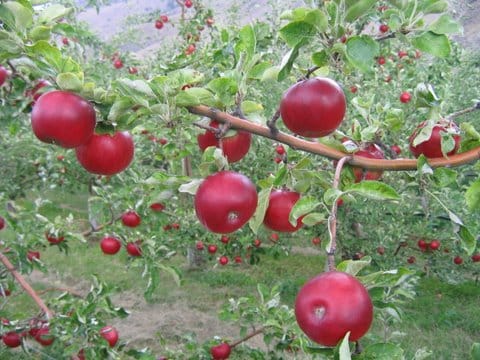
Honeycrisp is the apple that redefined what a modern dessert apple could be. It’s famous for its unmistakable crackling crunch, big juice, and clean, sweet-tart flavor that stays refreshing instead of sugary. If you want a fresh-eating apple that feels special the moment you bite into it, Honeycrisp earns its reputation.

The fruit is typically medium to large with a bright, attractive finish and creamy-white flesh. Honeycrisp excels when eaten crisp right off the tree, but it also shines in the kitchen—holding texture in salads, baking into a balanced sweet-tart apple flavor, and slicing beautifully for snacks and lunches.

Honeycrisp blooms mid-season and needs a compatible apple variety nearby to pollinate. With good light, consistent watering, and routine pruning, it becomes a reliable producer and a true centerpiece tree for any home orchard.

Overview

  • Premium fresh-eating apple known for explosive crunch and juiciness
  • Sweet-tart flavor that’s bright, clean, and refreshing
  • Great for snacking, slicing, salads, and baking
  • Mid-season bloom; fall harvest
  • Requires a pollination partner planted within 20–30 feet

Growing Details

Latin Name: Malus domestica ‘Honeycrisp’
Site and Soil: 1/2 day to full day of sun; well-drained soil
Hardiness: USDA Zone 4–7
Rootstock: M-106
Bearing Age: 1–3 years
Size at Maturity: Typically 12–15 ft tall and wide on semi-dwarf; easily maintained with pruning
Bloom Time: Mid-season (mid flowering group)
Ripening Time: Mid to late season; fall harvest (timing varies by region)
Pollination: Not self-fertile; requires a compatible apple variety planted within 20–30 feet
Pests & Diseases: Typical apple pest and disease pressures; best managed with airflow, sanitation, and routine orchard care
Yield: Heavy and reliable once established

Additional Notes

  • Grower’s Insight: Honeycrisp’s signature crunch comes from uniquely large, crisp cells—consistent watering helps maintain texture and reduces internal stress that can lead to quality issues.
  • Regional Insight: Honeycrisp is at its best in regions with true winter chill and moderate summer heat—especially the Upper Midwest, Northeast, and the Pacific Northwest—where it colors well and stays intensely crisp.
  • Thin fruit in heavy-set years to improve size, flavor, and overall eating quality.
  • For best harvest timing, pick when background color shifts and seeds are dark—Honeycrisp is meant to be eaten crisp, not soft-ripened.
  • Explore more apples in our collection: Apple Trees
Planting & Care

At a Glance – Honeycrisp Apple

  • Sun: 1/2 day to full day of sun
  • Soil: Well-drained soil; avoid prolonged saturation
  • Water: Moderate; consistent moisture during establishment
  • Size: Semi-dwarf; easily maintained with pruning
  • Pollination: Requires a compatible apple partner
  • Harvest: Fall (timing varies by region)
  • Hardiness: USDA Zone 4–7

Planting & Care – Honeycrisp Apple

Site Selection

  • Choose a site with at least 1/2 day of sun; full sun supports best fruit quality and color.
  • Good airflow helps reduce disease pressure and supports consistent production.
  • Avoid low areas where cold air settles and late frosts linger.

Soil Preparation

  • Apples perform best in deep, well-drained soil.
  • If your soil holds water, improve drainage or plant on a slight mound/berm.
  • Incorporate compost if needed, but avoid heavy nitrogen at planting.
  • Ideal soil pH is between 6.0 and 7.0.

Planting Instructions

  • Dig a hole twice the width of the root system.
  • Plant with the root flare at or just above soil level.
  • Backfill with native soil and water thoroughly.
  • Mulch 2–3″ deep, keeping mulch several inches away from the trunk.

Watering & Fertilizing

  • During the first 1–2 years, keep soil consistently moist but not saturated.
  • Deep water 1–2 times per week during dry weather; increase during heat spells or windy conditions.
  • Once established (year 3+), deep watering every 7–14 days during dry periods is typically sufficient.
  • Apply a light, balanced fertilizer in early spring if growth is weak; avoid pushing excessive vegetative growth.
  • Consistency matters—steady moisture helps fruit size and eating quality.

Pollination

  • Honeycrisp is not self-fertile.
  • Plant a compatible apple variety within 20–30 feet for reliable fruit set.
  • Most mid-season blooming apples are good partners.

Pruning & Training

  • Train to a central leader or modified central leader for strong structure.
  • Prune in late winter to remove crossing limbs, open the canopy, and keep height manageable.
  • Summer pruning can help control vigor and improve light penetration for better fruit quality.

Fruit Thinning

  • Thin fruit after natural drop to improve size and reduce limb stress.
  • Thinning also helps the tree focus energy and supports better flavor development.

Harvest & Use

  • Harvest when fruit is fully sized and background color shifts from green toward yellow.
  • Honeycrisp is meant to be eaten crisp and firm—enjoy right away for peak texture.
  • Excellent for fresh eating, slicing, salads, and baking.

General Tips

  • Support heavy crops with good pruning and thinning.
  • Keep mulch pulled back from the trunk to prevent rot and pest issues.
  • Routine care and airflow are the foundation of long-term productivity.