Description
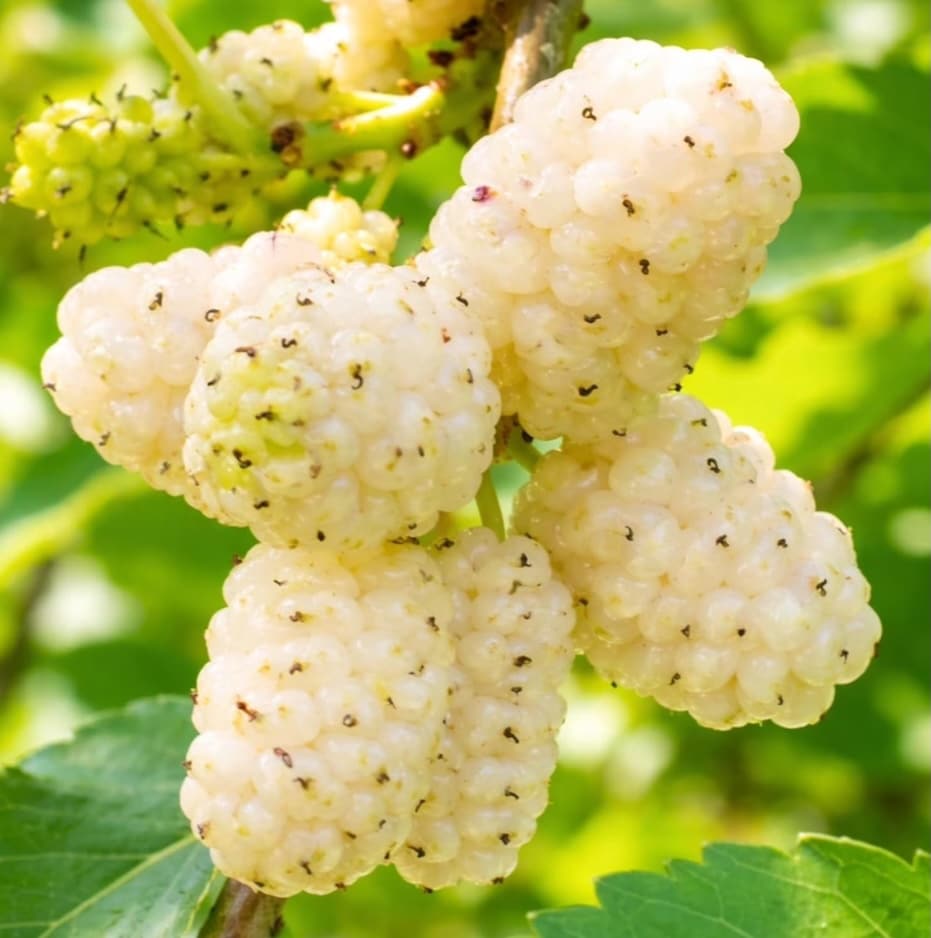
White Ivory is one of the better selections among white-fruited mulberries — a Morus alba cultivar producing roughly half-inch white fruit with a faint crimson blush at full ripeness. The fruit is notably sweet, with the mild, honeyed character white mulberries are known for, and does not stain hands, paths, or clothing the way dark-fruited mulberries do, which makes White Ivory a much easier mulberry to site in a garden where fruit drop on light-colored surfaces would otherwise be a problem.
The cultivar’s other distinguishing trait is its drying quality — White Ivory fruit dries into a raisin-like sweet snack that holds well in storage, and many growers plant the variety specifically for that purpose. Fruit ripens early in the mulberry season and concentrates over a short window rather than the long extended ripening typical of some white mulberries, which suits a single-harvest approach to drying and processing.
White Ivory is self-fruitful and suitable across roughly USDA Zone 5b–8. The tree is naturally large — capable of reaching 30 to 50 feet at full maturity in good conditions — and prefers full sun and well-drained soil. It is wind-pollinated, productive once established, and like mulberries generally is comparatively low-pressure for pests and diseases.
Overview
- White-fruited Morus alba mulberry — non-staining.
- Sweet ~1/2 inch fruit with a faint crimson blush.
- Excellent for drying; produces a raisin-like sweet dried fruit.
- Early-ripening over a short concentrated window.
- Self-fruitful; suitable across roughly USDA Zone 5b–8.
- Naturally large tree — 30–50 ft at full maturity in good conditions.
Growing Details
Latin Name: Morus alba ‘White Ivory’
Site and Soil: Full sun preferred; well-drained soil; tolerant of a range of soils
Hardiness: Suitable across roughly USDA Zone 5b–8
Rootstock: Grafted onto mulberry rootstock
Bearing Age: Typically 2–3 years after planting
Size at Maturity: Naturally large; capable of 30–50 ft at full maturity in good conditions; manageable with pruning
Bloom Time: Spring
Ripening Time: Early in the mulberry season; concentrated short window
Pollination: Self-fruitful; wind-pollinated
Pests & Diseases: Mulberry is comparatively low-pressure for pests and diseases across most growing regions
Additional Notes
- Grower’s Insight: White Ivory’s non-staining fruit and its quality for drying are the cultivar’s two practical advantages — the non-staining trait makes it sitable in gardens where dark-fruited mulberries would be a problem, and the drying quality gives a useful winter snack from a short concentrated harvest.
- Regional Insight: Mulberry performs broadly across temperate North America, and White Ivory’s Zone 5b–8 range covers most of that span — from the maritime Pacific Northwest through the Midwest, Northeast, and into the upper South.
- Explore more mulberry in our collection: Mulberry