Description
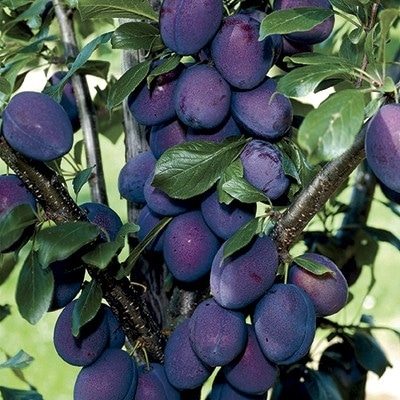
Stanley is the classic prune-plum for growers who want a tree that earns its keep—reliable harvests of deep blue fruit that can be eaten fresh, canned, or dried into real homemade prunes. When fully ripe, the sweetness explains why Stanley became the standard.
Developed in Geneva, New York through the New York State Agricultural Experiment Station breeding program and introduced in 1926, Stanley was selected for commercial performance. Its prune-type shape, high sugar levels, and freestone flesh make it especially well suited to drying without the need for pitting.
The fruit is oval with a dark blue-purple skin and yellow flesh that separates cleanly from the pit at maturity. While it can be enjoyed fresh, Stanley truly shines when preserved—whether canned, baked, or dried.
Overview
- European prune plum with classic elongated shape
- High sugar content suited to drying and preserving
- Freestone flesh at full maturity
- Reliable, productive tree
- Self-fertile; cross-pollination improves yields
Growing Details
Latin Name: Prunus domestica ’Stanley’
Site and Soil: 1/2 day to full day of sun; well-drained soil
Chill Requirement: Approx. 800 hours (best available estimate)
Hardiness: USDA Zone 5–9
Rootstock: Marianna 2624
Bearing Age: 1–3 years
Size at Maturity: Typically maintained at 10–14 ft tall and wide with pruning
Flowering Time: Mid to late flowering (within European plums)
Ripening Time: Mid to late season
Pollination: Self-fertile; plant a compatible European plum within 20–30 feet for increased yield and consistency
Pests & Diseases: Standard European plum considerations; good airflow is important
Yield: Heavy and dependable once established
Additional Notes
- Grower’s Insight: Stanley’s prune-type flesh, high sugar, and freestone behavior allow fruit to be dried without pitting—a key reason it became a commercial standard.
- Regional Insight: Performs reliably across temperate regions, including the Pacific Northwest, where it has long been a dependable European plum.
- Split pit can occur in some seasons; harvesting at full maturity helps minimize issues.
- In regions prone to black knot, proactive pruning and sanitation are important.
- Explore more plums in our collection: Plum Trees