Mulberry (Persian Dwarf Everbearing)

Price range: $29.99 through $69.99

Persian Dwarf Everbearing is a naturally compact mulberry that stays small and produces sweet dark berries over an extended season—well suited to patios, containers, and small gardens.

  • Naturally dwarf, space-efficient growth habit
  • Extended harvest window compared to standard mulberries
  • Sweet, dark berries for fresh eating and snacking
  • Easy to manage in containers or small landscapes
  • Self-fertile
Add to Wishlist
Add to Wishlist
SKU: Mulberry (Persian Dwarf Everbearing) Categories: , Tag:

Description

Persian Dwarf Everbearing is valued for doing something most mulberries don’t: staying genuinely small without constant pruning. Its compact habit is inherent to the variety, making it a practical choice for patios, containers, borders, and tight garden spaces.

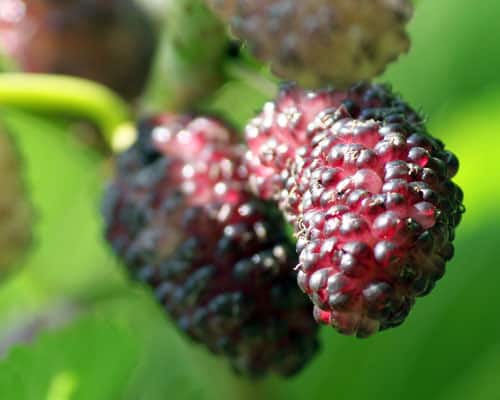
The tree produces dark purple to black mulberries with a pleasant sweetness and fruits over an extended period rather than in a single short flush. While “everbearing” doesn’t mean nonstop fruiting, growers can expect repeated waves of ripe berries through the season, especially in warm conditions.

Overview

  • Naturally compact mulberry suited to containers and small gardens
  • Extended fruiting season compared to many standard mulberries
  • Sweet, dark berries for fresh eating
  • Easy to manage without aggressive pruning
  • Self-fertile and beginner-friendly

Growing Details

Latin Name: Morus alba ’Persian Dwarf Everbearing’
Site and Soil: 1/2 day to full day of sun; well-drained soil
Hardiness: USDA Zone 6–9
Rootstock: Own-root (not grafted)
Bearing Age: 1–3 years
Size at Maturity: Typically 4–8 ft tall and wide (varies with container size and pruning)
Flowering: Spring; inconspicuous catkins (not showy)
Ripening Time: Late spring through summer; timing varies by climate
Pollination: Self-fertile
Pests & Diseases: Generally low-maintenance with few serious issues
Yield: Moderate; steady over an extended season once established

Additional Notes

  • Grower’s Insight: The appeal of Persian Dwarf Everbearing is that its size is inherent to the variety. It behaves like a small plant because it is one—not because it’s constantly being held back.
  • Regional Insight: Performs best in warm and temperate climates; in colder regions, container growing with protected overwintering helps maintain vigor and fruiting consistency.
  • Harvest fruit when berries are fully dark and soft for best sweetness.
  • Compact plants can still drop fruit—place thoughtfully near hardscape.
  • Explore more mulberries in our collection: Mulberry Trees
Planting & Care

At a Glance – Persian Dwarf Everbearing Mulberry

  • Sun: 1/2 day to full day of sun (more sun = better fruiting)
  • Soil: Well-drained soil; excellent drainage is critical in containers
  • Water: Moderate; keep evenly moist while establishing
  • Size: Naturally compact; ideal for pots and small gardens
  • Pollination: Self-fertile
  • Harvest: Late spring through summer; timing varies by climate
  • Hardiness: USDA Zone 6–9 (container culture recommended outside this range)

Planting & Care – Persian Dwarf Everbearing Mulberry

Site Selection

  • Give the plant as much sun as possible for the best fruiting and sweetness.
  • Containers should be placed where they receive long, uninterrupted light.
  • Choose a location where fallen fruit won’t be a problem on hardscape.

Soil Preparation

  • In-ground: plant in well-drained soil; avoid low spots that stay wet.
  • In containers: use a high-quality, free-draining potting mix.
  • A soil pH of roughly 6.0–7.5 is suitable.

Planting Instructions

  • Plant at the same depth it was growing in the pot.
  • Set the root flare at or just above soil level.
  • Water thoroughly after planting to settle soil around roots.
  • Mulch lightly in-ground, keeping mulch away from the trunk.

Watering & Fertilizing

  • Water consistently during the first growing season.
  • In containers, water when the top inch of mix dries; avoid staying constantly wet.
  • Feed lightly in spring and early summer if growth is weak; excessive nitrogen can reduce fruiting.

Pruning & Size Management

  • Minimal pruning is needed—this variety naturally stays compact.
  • Light dormant pruning can improve shape and encourage productive wood.
  • Tip pruning during the growing season can keep container plants dense and tidy.

Harvest & Use

  • Harvest when berries are fully dark and soft for best sweetness.
  • Pick regularly during the season as fruit ripens.
  • Excellent fresh, and also great for freezing, syrups, and jams.

General Tips

  • Flavor and yield improve as the plant matures.
  • In cold regions, overwinter containers protected once the plant is fully dormant.
  • Birds love mulberries—netting can help if they beat you to the crop.