Description
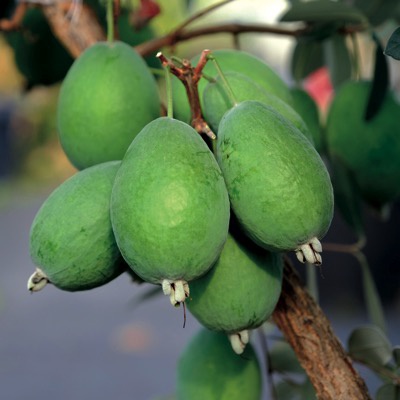
EarliHart™ was selected from seed shared by New Zealand plant breeder Roy Hart, and named in his honor. It was bred, with collaborator Nigel Ritson, for large fruit, thin edible skin, and sweet flavor, and specifically for early ripening among feijoa selections.
That early finish is the reason to plant it: in a cool-summer growing season that struggles to ripen other feijoas before fall frost, EarliHart™ is bred to get there first. The fruit is sweet and juicy with the clear pineapple-and-mint flavor the species is known for.
The tree flowers in early summer with showy red and white blooms, and the thick petals are edible, often pulled for salads without sacrificing the fruit set.
Overview
- Earliest-ripening feijoa in its Roy Hart breeding line
- Sweet, juicy fruit, pineapple-and-mint flavor
- Large fruit, thin edible skin
- Showy, edible red and white summer flowers
- Partially self-fertile
- Hardier than it looks; an established plant shrugs off brief single-digit cold
Growing Details
Latin Name: Acca sellowiana (syn. Feijoa sellowiana) ‘EarliHart’
Site and Soil: Full sun; well-drained soil; shelter from wind in marginal climates
Hardiness:Hardy to roughly 10F – mature plants have survived lower
Rootstock: Grafted onto pineapple guava seedling rootstock
Bearing Age: 2 to 3 years after planting
Size at Maturity: Approximately 8 to 10 ft – often maintained smaller; trains as a small tree or hedge
Ripening Time: Among the earliest-ripening pineapple guavas; early to mid-season
Pollination: Partially self-fertile; better cropping with a second pineapple guava within 20 ft
Pests & Diseases: Generally low-pressure; standard fungal care helps in humid, wet seasons
Additional Notes
- Grower’s Insight: A second, genetically different feijoa nearby improves the crop, but EarliHart™ will still set fruit on its own; the early ripening is the trait worth planning around.
- Regional Insight: Feijoas suit mild-winter regions best; where winters drop much below 15°F, plant in a sheltered, sunny spot or grow it in a container you can move under cover.
- Explore more pineapple guavas in our collection: Pineapple Guavas